The Helicopter View: Sugar Taxes, Supply Chains and the Never-Ending Protein Arms Race
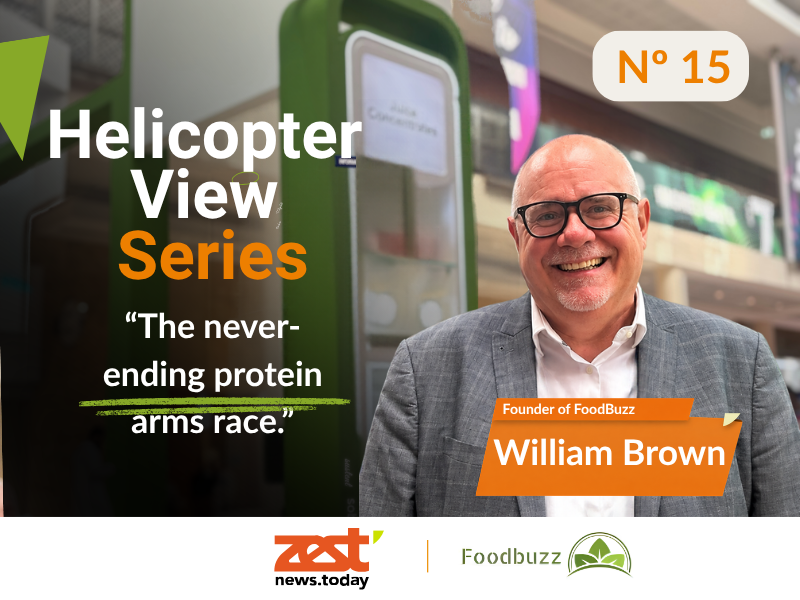
What's your background, and what led you to work across dairy, beverage, and fresh produce before finding FoodBuzz?
I started life as an electrical engineer. I entered the food industry 32 years ago, when I was 26, with no real plan to stay. I came from a different background, working with metals and explosives, weirdly. But I enjoyed it, quite frankly. I think it's because it's fast-paced, especially in fresh produce, dairy, juice: always something new. And because retail is such a fast-moving industry, there's constant new product development, always something happening. Once I was in it, that's kind of why I stayed. It's an interesting, sometimes frustrating job, but it's served me well. I've been fortunate to work in dairy and beverage, and during my time in the Middle East I also gained experience in poultry and post-harvest fresh produce. You're always learning something new, and I'm a curious guy, so it suits me.
Looking back, was there a specific gap in the Middle East market that led you to launch a consultancy rather than stay on the operator or producer side?
I don't think I necessarily saw a gap. There are quite a lot of consultants working in this business. If there's a benefit I bring, it's that an awful lot of them aren't based here; they come in and out from Europe or the US. Having been long established here (ten years in the UAE and four years in Saudi Arabia, fourteen years in the region altogether) gives me an advantage, and that was one of the reasons I chose to do it. I understand the market here, and of course it is different: every part of the world is different, and business is always moving forward here too, so that presents its own challenges. But primarily it wasn't about a gap. It was about a new challenge, some variety, and hoping I had something to bring with the experience I'd gained over 32 years. This is home to me, not somewhere I come to work transiently and then leave.
What did the regional food and beverage landscape look like when you started FoodBuzz, and how is it different today?
It's different because I think everything has matured. When I came here, the choices on the shelves weren't necessarily as healthy or as nutritious as they are now. If you go back 14 years, juice here was primarily sugar, a huge amount of sugar. The biggest change I've seen is a maturing market: consumers are much better informed, and I think social media plays a big part in that. Regionally, governments in the UAE and Saudi Arabia moved with it too: they introduced sugar taxes and started driving the unhealthy element out of the market. Milk is milk, milk doesn't change, but so many other products have come around it. Greek yogurt has been a phenomenon here over the last five or six years, and you cannot dismiss the rise of high-protein products, and that doesn't look to be easing up. Most of the dairies here used to just make a bit of yogurt, a bit of milk, some flavored milks, some very sweet juices, and that was their portfolio. Now their portfolio is probably twice the size, with functional drinks and protein offerings. But again, it's driven by the consumer: the consumer is more informed, and the retail market here is more mature now too.
What was a project or client relationship from your 30 years in the industry that shaped how you approach your work now?
Probably my first year or two in Saudi Arabia, coming from Europe. Culturally and from a business perspective it's a different market, and the learning curve is very steep. I couldn't point to one particular project, but that first year or two really gave me shock therapy. I had to adapt very quickly, from a project management point of view, to things that would be instantly to hand in Europe but weren't instantly to hand there. It served me very well, to be honest, and it's one of the reasons I have such a fondness for Saudi Arabia. It was good to me, in so many ways. I was also working with a team there that was very results-driven: the outcome was everything. Yes, we had a set process and we followed it, but it was never done without losing sight of the fact that there was a clear objective at the end. That's something I still take into how I work now. I can't necessarily produce the fanciest-looking PowerPoint, but I can get it done, get it done well, and get it done on time. That's truly what the client wants: the result, the revenue, something he can use.
What's the best piece of advice you've ever received?
This is one I can't really repeat for print. Someone gave it to me very early in my career, in fairly blunt language, about getting through hard days regardless. But the lesson behind it has stuck with me ever since: keep clear demarcations in what you do. Work hard, your nine or ten hours a day, and then stop, and start fresh the next day. If you have chaos, stress, people confused, being pulled too many ways at once, you don't get results. I think there's actually more of a work-life balance here than in Europe; family is still very important in this region. From a business perspective, the other lesson was: you can't win them all. You just keep aiming for the end goal and keep going, rough days included.
Thinking back over the last decade or two, what's the single biggest shift you've seen in how beverages are produced and distributed in the Middle East?
I'd go back to the changing market. That's been the biggest shift, I think: quality. There's a real awareness now of nutritional offerings that wasn't there 10 or 15 years ago. And then there's post-COVID: food security suddenly went to the top of the agenda, with a very clear government strategy. If you want to grow fresh produce in a desert environment, you have no choice but to innovate: take the best technology from around the world and develop your own. If I look at what was on the shelves 10 years ago versus now, it's a huge step forward. And the big names aren't dominating the way they used to. There are quite a few niche manufacturers now. There's an Italian dairy here where I can buy fresh burrata off the shelf, made by an Italian cheesemaker. That's where the real shift has come: locally produced, but high quality.
What's now the biggest challenge or risk you see facing the industry?
Right now, it's supply chain: raw material cost and supply chain. If you look at a lot of the big dairy farms here, they're usually attached to a dairy producer. There's a company called Almarai, the biggest vertically integrated dairy business in the world: something like 300,000 cows spread across a number of sites, a scale most people can't really comprehend. But virtually none of the feed they use can be grown here; it's all imported. So the next immediate challenge this industry faces is supply chain. I speak to dairy. farmers, and it's the same story in juice: whether you're bringing juice in from Rotterdam or wherever,
you run into the same problem. It really is supply chain; that's the major challenge. That said, in the UAE there are two smaller ports that aren't affected by the Strait of Hormuz, and the government has already announced major investment and development plans for them. They're not going to let this happen a second time: within weeks and months they said, we're expanding this port by this amount, starting immediately, here's the investment. So this will pass, we know it will pass. But at the moment, the biggest pressure is supply chain and rising costs, and every country is feeling it: this is a desert environment with a dependency on imports. It's not that ingredients haven't been available; it's that costs have risen quite sharply. I know what farmers were paid for a ton of alfalfa six months ago compared to now: it's a considerable difference. So across the board, that's the biggest challenge the industry faces right now: the cost of ingredients, the cost of transport, and supply chain.
Do you feel producers, retailers, and regulators read the market differently?
That's a good question. If you understand how the market works here (this is true of both the UAE and Saudi Arabia) , the Government keeps a close eye on the price of commodities like milk, chicken, rice, set yogurt, the staple day-to-day essentials. I don't think there's a huge gap between retailers, producers, and regulators. I think they work hand in hand, and they meet very regularly, even at quite a high level. There's a reason the UAE is so successful. It's not an accident. There's a reason why, in the space of 55 years, it's gone from small creekside towns to what it is today.
In one sentence, how would you describe the current state of the Middle East dairy and beverage market?
Healthy. There are some great products out here, some great producers, and a lot of innovation coming to the shelves. Geopolitically we're in a difficult time, and you get a sense that decision-making is taking a closer degree of scrutiny because everyone's having to adapt to difficult circumstances, but this region isn't doing that for the first time, and it adapts well. I bought a can of a cola drink yesterday (not Coke, a local one, sweetened with monk fruit, zero calories, inexpensive, wraparound paper label, clearly a small producer) and it was a really nice drink. That kind of innovation is still coming through. So: healthy, feeling some pressure, but healthy. We'll all breathe a sigh of relief once there's more stability.
What's the biggest single opportunity you see in this market over the next three to five years?
I don't see any letup in well-informed consumers looking for functional products; that's where the opportunity will keep coming, especially in the major centers like Abu Dhabi, Dubai and Riyadh. Outside the big metro areas it's a very different world, one that doesn't really care so much about “functional” yet, but in the capitals, it's a continuation of innovation around nutrition and what I call the never-ending protein arms race. Combine this with the push for even greater food independence and I believe the future is looking good and there will be no shortage of opportunities.
Watch more here: https://youtube.com/shorts/XmiaxEnBZxA?feature=share






