Kraft Heinz’s US beverage portfolio spans six brands
Kraft Heinz was established in 2015 through the combination of Kraft Foods Group and the H.J. Heinz Company, a transaction valued at $28 billion. The US-based food company holds dozens of brands internationally. Its American drinks business covers coffee, fruit beverages, lemonade and products for flavouring water. Several of those brands previously belonged to General Foods and subsequently became part of Kraft. Across the portfolio, product formats have expanded beyond their original powders or packaged drinks: Country Time, Crystal Light and Kool-Aid now also offer liquid concentrates that consumers squeeze into water.
Capri Sun originated in Heidelberg, Germany, in 1969 under the name Capri-Sonne. Its name combined a reference to the Italian island of Capri with the German word for sun. Orange and lemon were its first flavours, sold in a stand-up pouch that introduced that packaging format to German supermarkets. Shasta Beverages Inc. brought the drink to America in the early 1980s through a licensing agreement with a West German business. Among its initial rivals were Hi-C and Hawaiian Punch; Capri Sun’s pouch could also be frozen to produce a slush. Kraft General Foods bought the brand in 1990, adding it to a business that already included three powdered-drink brands. Capri Sun has experienced incidents of mould developing inside its pouches and remains a participant in the American fruit-drinks market.
General Foods launched Country Time powdered lemonade in the United States in 1975. The brand later passed into Kraft General Foods and then Kraft Heinz, while its range grew to include ready-made beverages. Two class-action cases concerning its products remain pending. A suit brought in Alabama in 2022 alleged that a container of powder produced as much as two quarts less lemonade than the quantity stated on its label. Another, filed in late 2025, challenged the descriptions “No Artificial Flavors” and “Naturally Flavored”. The plaintiffs allege that these claims are misleading because the drinks contain ingredients they identify as artificial, including citric acid, sodium citrate, potassium citrate and maltodextrin.
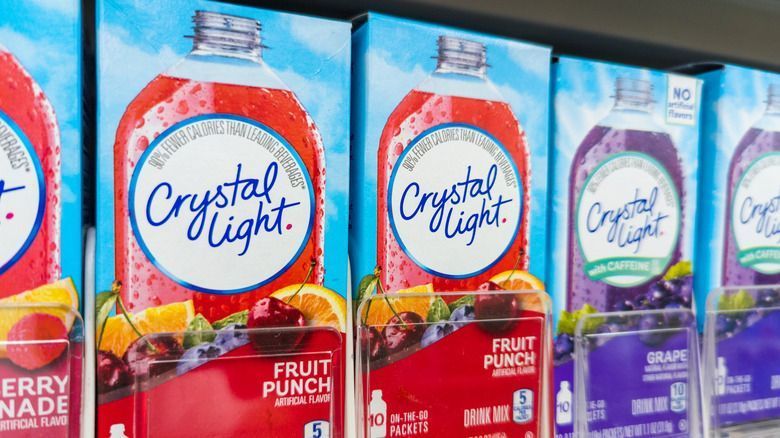
Crystal Light emerged in the early 1980s, as manufacturers explored demand for drinks and mixes without sugar. General Foods introduced it around the time it released sugar-free Kool-Aid. Both used Nutrasweet, with Crystal Light directed at adults and the Kool-Aid product at children. Crystal Light’s initial selection comprised iced tea, fruit punch, orange, lemon-lime and lemonade. The range is intended to encourage water consumption by adding flavour. Some versions contain vitamins and minerals and are promoted for immune support; others include caffeine and are marketed for energy. Advertising has predominantly addressed women, although the company estimated in 2009 that men accounted for 40% of consumers.
Edwin Perkins developed Kool-Aid in 1927 after taking inspiration from powdered Jell-O desserts. His powder offered an alternative to flavoured syrups shipped in glass bottles, which were liable to break in transit, and its packets were easier to send by post. Initially called Kool-Ade, the product received its current spelling in 1934 following a dispute with the US Food and Drug Administration over the suffix “-ade” and possible confusion about fruit content. General Foods acquired it from Perkins in 1953. Subsequent additions included more flavours and sour varieties. The Hydration range announced in 2026 targets active consumers and is advertised as containing neither sugar nor artificial dyes. Its four electrolytes are sodium, potassium, calcium and magnesium.
Maxwell House dates to 1892, when its coffee was served at the Maxwell House Hotel in Nashville, Tennessee. General Foods acquired the brand in 1928, and it became one of America’s leading coffee sellers during the following decades. Philip Morris, then the parent of both General Foods and Kraft, combined the businesses. Cost-cutting at Maxwell House subsequently included closures of manufacturing sites around the United States. By 2025, Jacksonville, Florida, housed its sole remaining American processing plant. The brand uses Arabica and Robusta beans grown in tropical regions outside the country. Those beans are brought to Jacksonville for roasting, processing and packing before the finished coffee is dispatched.
Kraft introduced MiO in 2011 as a liquid concentrate for flavouring water. Its name means “mine” in Italian, and a standard pocket-sized bottle provides 24 servings, depending on the amount used. The range comprises the original MiO product, Hydrate with electrolytes, Energy with caffeine, and Vitamins. At launch, Roxanne Bernstein, then the brand’s director, described it as “an entirely new category”. Competing liquid water enhancers subsequently appeared alongside MiO in grocery shops. Its electrolyte offering shares that product feature with the newer Kool-Aid Hydration range, while Country Time, Crystal Light and Kool-Aid have also adopted the squeeze-bottle format for their own liquid products.






