
Clorox yields 5.4% against PepsiCo’s 4.3%, but has weaker dividend coverage
PepsiCo recorded third-quarter net revenue growth of 5.6%, with organic revenue rising by 3.1% and core earnings per share increasing by 2%. Organic volumes increased in both its beverage and snack businesses. The company nevertheless reduced its full-year forecast for core earnings-per-share growth to 2.5%–3.5%. Previously, it had expected growth towards the bottom of a 5%–7% range. The revised guidance implies earnings of approximately $8.38 per share at the midpoint.
The comparison put PepsiCo’s shares roughly 19% below their highest level over the preceding 52 weeks. It identified inflation and the effects of GLP-1 weight-loss medicines among the pressures on the company, particularly in North America. At a reference price of about $138, the shares were valued at 16.5 times earnings. PepsiCo’s longer-term objectives call for organic revenue to expand at a mid-single-digit rate and core earnings per share at a high-single-digit rate. Separately, an embedded market quote showed the shares at $142.68, up $5.41, or 3.94%, at 3:29pm Eastern Time on November 4th 2026.
Clorox reported $1.9 billion in net sales for the opening quarter of its 2027 financial year, an increase of 33%. Adjusted earnings per share rose by 82%. Those increases reflected its purchase of GOJO and a reduction in inventories during the comparable year-earlier period associated with a software-platform change. Higher spending on commodities, manufacturing and logistics reduced its gross margin. Clorox now expects adjusted earnings per share towards the bottom of its $5.70–$6.00 guidance range for the financial year, implying growth of approximately 3%.
Clorox’s shares were about 27% below their 52-week peak in the comparison. Using a reference price close to $93 and the bottom of its earnings forecast, the stock traded at approximately 16.3 times earnings. Its annualised dividend was $5.00 per share, against PepsiCo’s $5.92. On the forward adjusted earnings estimates used in the analysis, dividends represented 88% of Clorox’s earnings and 71% of PepsiCo’s. A separate market quote placed Clorox at $99.76 at 3:30pm Eastern Time on November 4th 2026, a gain of $5.96, or 6.35%.
PepsiCo produced $10.5 billion of free cash flow during the preceding 12 months, compared with annual dividend payments totalling $7.9 billion. Clorox’s latest financial year generated $405 million in free cash flow, while dividend distributions amounted to $602 million. Its cash flow was affected by a $476 million payment to end a joint venture. PepsiCo had increased its dividend in each of the previous 64 years, giving it Dividend King status, a designation requiring at least 50 consecutive annual increases. Clorox was one year short of that threshold.
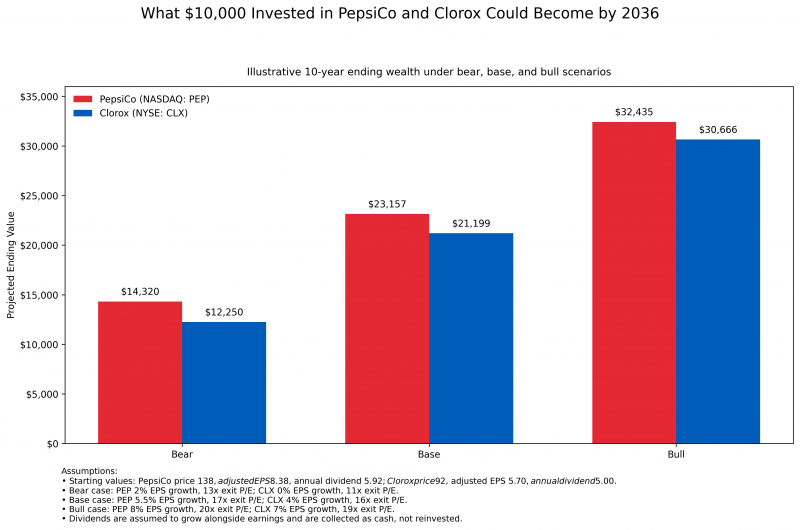
The Motley Fool author also modelled the possible value by 2036 of $10,000 invested in either company. The pessimistic scenario combined little earnings growth with lower valuation multiples. The central scenario assumed earnings per share would resume mid-single-digit growth while multiples remained unchanged. The optimistic scenario paired mid-to-high-single-digit growth with an increase in valuation multiples. PepsiCo delivered the higher modelled return in all three scenarios.
The author attributed that scenario ranking to an expectation that PepsiCo would grow somewhat faster than Clorox, citing its greater scale and stronger financial position. The comparison favoured PepsiCo for a decade-long investment, pointing to its food and beverage operations, dividend coverage and valuation. It described Clorox as offering more current income and potential gains from a successful turnaround, while identifying its high payout ratio and continuing cost pressures as risks.


